
Most recreational runners treat strength training as something they’ll get to eventually — after the next race, when the mileage drops, when there’s more time. The result is predictable: tight hips, a struggling IT band, a knee that starts complaining somewhere around kilometre 15. Strength training does not make you slower or heavier. Done right, it makes you more efficient, more resilient, and harder to break down over a long season.
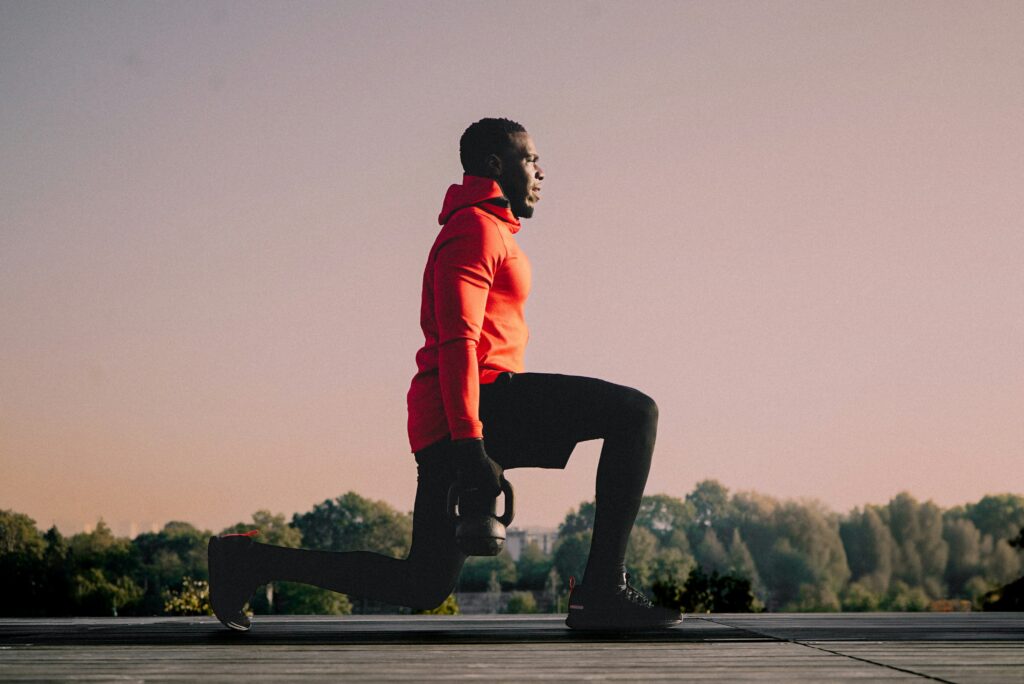
Why Runners Need to Lift
Running is a unilateral sport. Every stride puts your full bodyweight on a single leg for a fraction of a second, and over the course of a 90-minute long run, that force accumulates into thousands of repetitions. When the muscles supporting that movement — glutes, hamstrings, hip stabilisers, core — are underdeveloped, the joints absorb what the muscles cannot handle. That is where runner’s knee, IT band syndrome, and shin splints tend to come from: not bad luck, but a strength gap.
Beyond injury prevention, strength work directly improves running economy. A 2014 meta-analysis in the British Journal of Sports Medicine found that resistance training reduced injury rates in sports by roughly 66%. More practically for recreational runners, stronger glutes and calves mean more force with each push-off, better maintenance of form in the final kilometres of a race, and less energy wasted on compensatory movement patterns. The goal is not to look like a weightlifter — it is to run the same pace with less effort.
What to Train and Why
The most common mistake runners make in the gym is training what they already use well. They do plenty of quad-dominant movements — squats, leg press, cycling — while neglecting the posterior chain and single-leg stability that running actually demands. A useful framework is to think in four categories: glutes and hips, posterior chain, core, and calves and ankles.
The glutes are the engine. Weak glutes force the knee inward on every footstrike, which overloads the IT band and kneecap over time. Single-leg glute bridges, step-ups, and lateral band walks are among the highest-return exercises a runner can do because they replicate the single-leg loading of running itself. The hip abductors — the small muscles on the outer hip — deserve specific attention; they are chronically undertrained in runners and play a major role in keeping the pelvis stable on each stride.
The posterior chain encompasses the hamstrings, glutes, and lower back. Romanian deadlifts and Nordic curls are exceptional for this group. The hamstrings in particular are a common weak point in runners: they work hard eccentrically on every stride to decelerate the leg before foot strike, but they rarely get trained through that range of motion in typical lower-body routines. Strengthening them eccentrically — meaning under load while lengthening — has a direct protective effect against hamstring strains and contributes meaningfully to stride power.
Core strength for runners is about stability, not movement. A plank, a dead bug, and a Pallof press develop the anti-rotational stiffness that keeps your upper body quiet while your legs work beneath you. Running economy worsens significantly when the core fatigues, because energy starts leaking sideways instead of going forward. This does not require long core sessions — two or three targeted exercises done consistently will produce results most runners can feel within four to six weeks.
Calves and ankles are often overlooked because the calves do get some work from running itself. But the Achilles tendon is one of the most injury-prone structures in distance runners, and heavy calf raises — particularly single-leg, with a slow lowering phase — significantly improve tendon resilience. This is one of the few areas where load and tempo genuinely matter more than pure movement pattern.
How to Structure It
Two sessions per week is the evidence-based sweet spot for recreational runners: enough stimulus to build meaningful strength, not so much recovery demand that it competes with your running sessions. Strength work should be scheduled on the same days as easy runs or on rest days — never the day before a hard workout or a long run.
Each session does not need to be long. Forty to fifty minutes is sufficient if the exercises are well chosen and the rest periods are managed. A simple session structure that covers all four categories might look like this: begin with a short activation sequence targeting the glutes and hips — clamshells, lateral band walks, a set of glute bridges — then move into your main compound movements. A single-leg Romanian deadlift and a step-up cover the posterior chain and glute work simultaneously. Add a plank variation and a Pallof press for the core, and finish with single-leg calf raises. That is five exercises, and it addresses the injury risk profile of a recreational runner comprehensively.
During a heavy training block — the six to ten weeks before a target race — it is sensible to reduce the volume of strength training rather than eliminate it. Maintaining the pattern and intensity while cutting sets from three to two preserves the neuromuscular adaptations without adding recovery burden. Complete strength deload in the final two weeks before a race is generally fine, as strength adaptations persist much longer than a two-week taper.
Equipment: What You Actually Need
The honest answer is that most of the highest-value strength work for runners requires minimal equipment. A set of resistance bands covers lateral band walks, clamshells, glute bridges with added load, and banded squats. A pair of dumbbells extends the range significantly — Romanian deadlifts, step-ups with load, single-leg calf raises holding weight. A mat and a floor cover the rest.
If you want a single piece of equipment to start with, a resistance band set is the most practical choice. The TheraBand Professional Resistance Bands are the standard that physiotherapists use in clinical settings — colour-coded by resistance level, made from natural latex, and available as a three-band starter set that covers activation work through to loaded strengthening. The loop bands are particularly useful for glute activation before runs — a short sequence of clamshells and lateral walks before heading out the door takes less than five minutes and makes a noticeable difference in how the hips engage during the first kilometre.
When you’re ready to add load, a kettlebell is worth considering over a standard dumbbell for one specific reason: the offset centre of mass. Because the weight hangs below the handle rather than sitting symmetrically in your palm, every exercise recruits additional stabiliser muscles to control the movement — which is exactly the kind of demand that transfers to running. A kettlebell swing is one of the most efficient hip-hinge exercises available, training the glutes and hamstrings through a powerful extension pattern that maps directly onto push-off mechanics. A single-leg Romanian deadlift with a kettlebell adds a rotational challenge that a dumbbell does not, and goblet squats done slowly build anterior core control alongside quad and glute strength. One kettlebell in the 12–16 kg range, combined with resistance bands, covers the majority of what a recreational runner needs for a full home programme. If gym access is convenient, the cable machine and a barbell open up Nordic curls and heavier hip hinging — but neither is necessary to see substantial results.
For recovery between strength sessions and runs, a foam roller helps manage muscle soreness and maintain tissue quality during periods of higher training load. The best foam rollers for runners are covered separately — it is worth reading before investing, since density and texture matter more than most people realise when you are trying to address specific tight spots like the IT band or calves.
A Note on Progression
The biggest mistake runners make with strength training is staying comfortable for too long. The body adapts relatively quickly to a given stimulus, and if you are doing the same exercises at the same weight for months on end, you will plateau. Progression does not have to be complicated: adding one rep per set each week, or increasing the load by a small increment every two to three weeks, is sufficient to drive continued adaptation.
Start with bodyweight for the first two to three weeks to establish movement quality. Then add load — even a light resistance band or a small dumbbell — and work with that until the final reps of each set feel genuinely challenging but manageable. That last distinction matters: you should finish a set feeling like you could do two or three more, not twenty. Training to actual fatigue is appropriate for recreational runners working on injury prevention; training to absolute failure introduces too much recovery demand on top of the running load.
Over a full training year, think in blocks. A general preparation phase of eight to twelve weeks in the off-season or early in a new training cycle is where you build baseline strength across all categories. As race-specific training intensifies, volume drops and you shift toward maintaining what you have built. Post-race, a short deload followed by a new general preparation phase resets the cycle. This structure keeps strength training purposeful rather than perpetual background noise.
If you are currently following a structured running plan and want to understand how strength training fits into a full training week, the running training guide covers periodisation, session structure, and how to manage load across different phases of a training cycle.
Want weekly running nutrition tips without the fluff? Join the THRUX newsletter.
This article contains affiliate links. If you purchase through these links, THRUX may earn a small commission at no extra cost to you.